


Finding flat ground first
My first run in Madrid lasted about four minutes before I hit a hill I hadn't seen coming, somewhere near Príncipe Pío. I'd been running since 2019, mostly on flat ground back home, and nothing had prepared me for a city built on this much incline. Madrid sits close to 700 metres above sea level, among the highest capitals in Europe, and the slope shows up everywhere, including places that look flat on a map.
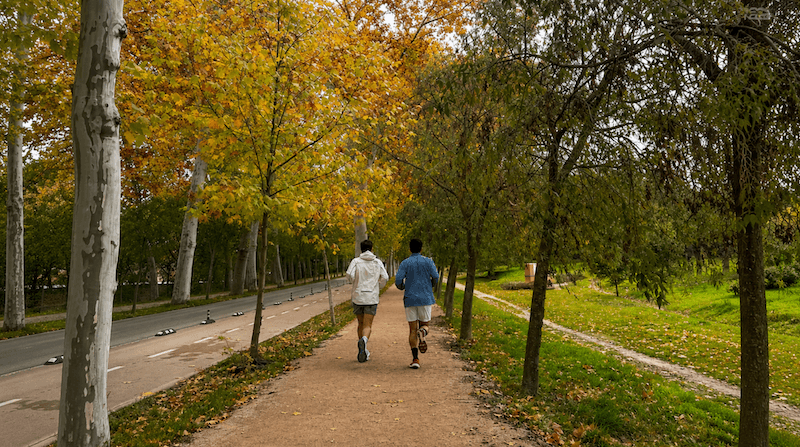
Madrid Rio was the fix. The stretch between Puente de Segovia and Legazpi runs about 4.5 kilometres along the Manzanares without a single real climb: paved, wide, with distance markers painted into the ground every 50 metres and fountains along the way. It's not scenic in the postcard sense, more river, joggers, cyclists and the odd heron, but it let me build a base without my legs arguing with the terrain. Weekends get crowded with families and skaters, so weekday mornings or evenings are the better window if you actually want to run rather than weave.
I spent most of that first autumn there, going back and forth under the Puente de Toledo, watching the light shift on the Palacio Real across the water. It's also where I'd point anyone landing in Madrid without much running behind them, expats included: no navigation needed, no surprises underfoot, and enough distance to string together a proper training block before venturing anywhere hillier.
El Retiro, the loop everyone eventually runs
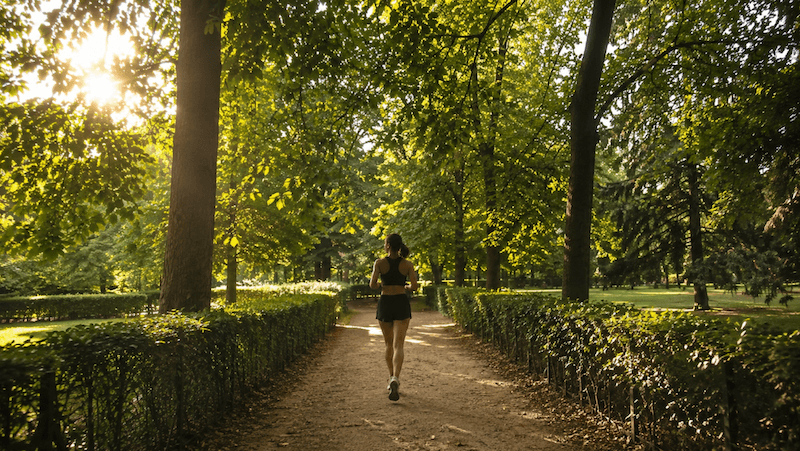
Once flat ground stopped being a novelty, El Retiro was the obvious next step, and it's the park most people mean when they ask where to run in Madrid. Yes, you can run there, and locals do, in far greater numbers than the tourists wandering the Palacio de Cristal. The classic loop follows the packed-dirt path along the inner fence line for close to 4 to 4.5 kilometres, though variants that swing wider through the Parterre Frances push it toward 5 or 5.8 kilometres depending on where you cut the corner.
The one honest climb is the Cuesta del Angel Caido, a roughly 500-metre stretch of asphalt on the Paseo de Fernan Nunez, short enough to not derail a session but steep enough to notice. The Paseo de Coches, the long straight avenue that splits the park, is where the interval groups gather most evenings. What struck me early on wasn't the terrain so much as the crowd: at peak hours the path along the fence can genuinely bottleneck, packed with runners, skaters and people just out for air.
What Madrid Rio gave me in confidence, El Retiro gave me in company. It's the one park where running stops feeling like a solo errand: outdoor gym equipment near the Puerta de la Reina Mercedes fills up with people mid-session, training groups cluster by the Estanque Grande on weekday evenings, and it's entirely normal to fall into pace with a stranger for a kilometre without either of you saying a word about it.
Somewhere between building a base at Retiro and taking on real hills, two more routes earned a permanent place in the rotation, less about elevation and more about what a given session actually needs.
Track work on Paseo de la Castellana
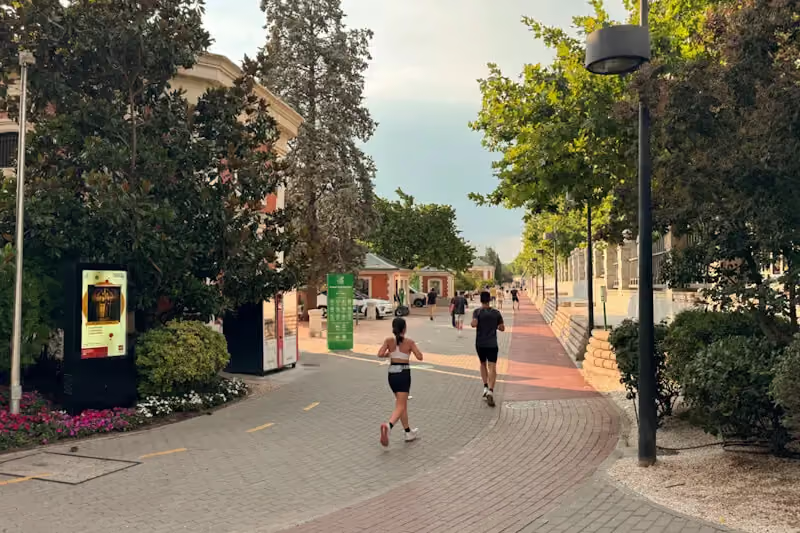
Paseo de la Castellana became useful once I needed speed rather than distance. The avenue runs dead straight for close to six kilometres, from Plaza de Castilla past the Bernabéu, the Cuatro Torres and the AZCA business district, down to Plaza de Colón. It's the route Madrid's biggest races start on, including the Madrid Marathon and the Zara Athleticz Speed Run, precisely because it's flat and wide enough for thousands of runners at once.
That flatness is also the catch. Castellana carries heavy traffic for most of the day, so it's not somewhere to linger at midday. Early mornings or after dark, once the buses thin out, are when it earns its place on a training plan: long, unbroken straights for tempo runs or repeats, with distance easy to gauge against the cross streets.
A quick loop when time is short: Parque del Canal de Isabel II
Some days call for a loop rather than a route, and Parque del Canal de Isabel II, in Chamberí, is where I go when I only have twenty minutes. The park circles a converted water reservoir with a 1.2-kilometre tartan track marked every 100 metres, flat enough that it barely counts as a session, and everyone runs it anticlockwise, an unwritten rule that keeps the narrow bends from turning into a pile-up.
It's too short for anything beyond intervals, but it's forgiving on tired legs and rarely crowded before the evening rush. The park sits right next to the Canal de Isabel II swimming pool, so on the hottest weeks the loop doubles as a warm-up before a swim next door. If a dip sounds better than another lap, we've mapped every public pool in the city here.
Chasing the sunset uphill in Parque del Oeste
By the time I could handle repeats without complaint, I'd moved on to Parque del Oeste, next to the Templo de Debod, and it humbled me a little. The loop runs about 4.3 to 4.5 kilometres, mixing asphalt with dirt, and the climbs are constant rather than occasional, particularly around Avenida de Seneca, where the path pitches upward for long enough to work your legs like a hill session. It's shadier than Retiro year-round, which matters in July, but it's not where I'd send someone in their first month of running.
The payoff is the view. Push up toward the ridge above Paseo del Pintor Rosales close to sunset and the Sierra de Guadarrama sits along the horizon past the temple's silhouette, one of the better reasons in Madrid to be out of breath on purpose.
Going long in Casa de Campo
The last piece fell into place once I needed real distance. Casa de Campo, the former royal hunting ground west of the river, has a perimeter close to 16 kilometres and enough interior paths to string together a proper long run without repeating ground. It sits near the INEF, Spain's national sports academy, so it's not uncommon to pass athletes clearly training for something more serious than a Tuesday jog. There's a zone locals call El Bosque, marked out in four-kilometre segments for anyone doing structured intervals.
The catch is real: fountains are scarce once you're deep inside, and the paths fork often enough that getting turned around is easy, especially the first few times. I'd still go in with someone who already knows the layout, or at least with a route saved on a watch, before attempting it solo. The entrance nearest the Lago metro stop is the simplest way in if you're starting cold.
By the time Casa de Campo made sense to me, running had stopped being about proving anything to the hills and started being the part of the day I looked forward to most, which is probably the actual point of moving through a city on foot rather than through a phone screen.
Earning the café con leche
These days the order barely matters. I rotate between all six depending on the session and the week, but the finish line ritual hasn't changed since that first disorienting run near Príncipe Pío: shoes still on, straight to whichever café earned the run. Every runner has a safe coffee place for each route, the one you don't have to think about. These are mine:
- Madrid Rio: Always Open
- El Retiro: Hola Coffee Lagasca
- Paseo de la Castellana: Gallobúho
- Parque del Canal de Isabel II: Run Run Run
- Parque del Oeste: The Fix
- Casa de Campo: Taberna El Urogallo Lago
FAQs
What's the best place to run in Madrid?
It depends on level and goal. Madrid Rio's flat 4.5-kilometre stretch between Puente de Segovia and Legazpi suits beginners and recovery runs, El Retiro works for most sessions and a social atmosphere, and Casa de Campo is the choice for long runs and trail-style terrain.
Can you run in Parque del Retiro?
Yes. It's one of the most popular running spots for Madrid residents, not just visitors, with packed-dirt paths running close to its perimeter and a straight, wide avenue (Paseo de Coches) commonly used for intervals.
How many kilometres is a loop of El Retiro?
The main perimeter loop runs roughly 4 to 4.5 kilometres. Variants that follow the outer paths more closely can stretch to around 5 or 5.8 kilometres.
Where should a beginner run in Madrid?
Madrid Rio's stretch between Puente de Segovia and Legazpi is the flattest well-known option in the city, with no real climbs, distance markers on the ground and frequent fountains.
What's the best time of day to run in Madrid?
It depends on the season. In winter, midday and evening generally beat early morning, when traffic and pollution are at their highest along busy roads. In summer, that flips: midday heat makes running genuinely rough, so before 8am or after 8pm is the better window. Parks like El Retiro and Madrid Rio are less affected by traffic either way, since they sit away from major roads.
