


El Rastro opening hours and the best time to go
For a lot of madrileños, Sunday has a fixed order: El Rastro first, then a caña or a vermouth in La Latina, then a lunch that runs well into the afternoon. Nobody needs a reason to go. People come down the hill for a lamp, a stack of old postcards or nothing in particular, and expect to bump into something they fall in love with on the way.
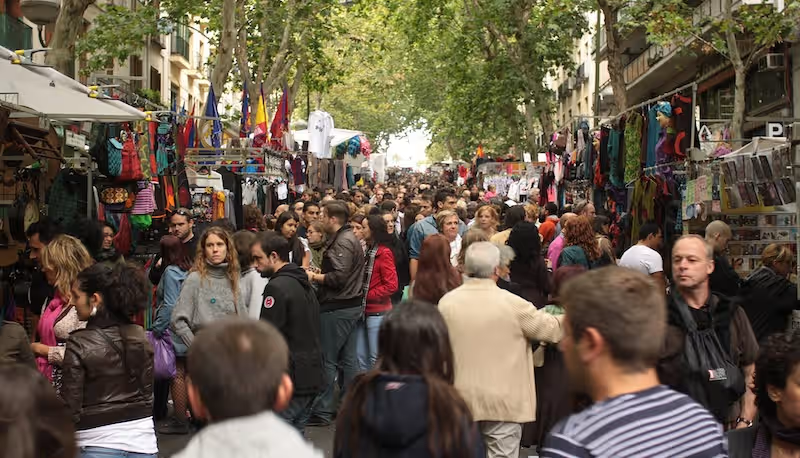
It all starts at Plaza de Cascorro (Maps), under the statue of Eloy Gonzalo, a soldier of the Cuban war who has stood at the top of the square since 1902. At nine in the morning the slope below him still has room to walk. By midday it is castizo Madrid at full volume: the barquillo seller in chulapo dress, a barrel organ playing somewhere in the crowd, and Calle de la Ribera de Curtidores moving at the pace of a queue.
That contrast is the main decision of the day. El Rastro runs from 09:00 to 15:00 every Sunday and on public holidays, and the hours on either side of 11:00 are two different markets. Early is for buying: room to stop, traders with time to talk, the full stock still on the table. From late morning the crowd is the event, and it is at its thickest between midday and closing. The end also comes sooner than the timetable suggests, because stalls start packing up at about 14:30 and most are gone by 15:00.
Weather rarely changes the plan. The market goes ahead in the rain, though in a heavy downpour some of the stalls selling paper and delicate antiques stay away.
How to get to El Rastro by metro
Which metro station to use decides which way the hill goes. La Latina on line 5 and Tirso de Molina on line 1 both come out a few minutes' walk above Plaza de Cascorro, so the whole market lies downhill from there. Embajadores (line 3) and Puerta de Toledo (line 5) sit at the bottom end, near Ronda de Toledo, which means climbing Ribera de Curtidores against the flow. Arriving at the top and leaving from the bottom keeps the walk in one direction.
A car does not help on market mornings. The streets the stalls occupy are closed to traffic, and the whole area sits inside the Distrito Centro low-emission zone.
What to buy at El Rastro, street by street
From Plaza de Cascorro the market reads as a single street. It works more like a map. Ribera de Curtidores is the trunk: the widest and busiest stretch, lined with new clothes, shoes, bags, hardware and outdoor gear. On its own it is the least distinctive part of El Rastro, and most of what people come looking for is one turn away from it.
Calle de San Cayetano is known as the painters' street, with oils, prints and art supplies. Calle de Fray Ceferino González still answers to the street of the birds, although the animal trade that gave it the name has shrunk to a few shopfronts. Second-hand and antiquarian books collect on Calle de Carlos Arniches and Calle del Carnero. Plaza del General Vara del Rey mixes second-hand clothes with coins, comics and vinyl, and the two streets called Mira el Río, Alta and Baja, deal in the small stuff of house clearances: old photographs, postcards, typewriters, film cameras. Calle de Rodas and Plaza del Campillo del Mundo Nuevo are where collectors trade cards, stamps and back issues of magazines.
The more expensive antiques are indoors. Galerías Piquer and the Nuevas Galerías both open off Ribera de Curtidores, with dealers in furniture, paintings and decorative pieces, and the shops along the street keep trading from Monday to Saturday, when the stalls are gone.
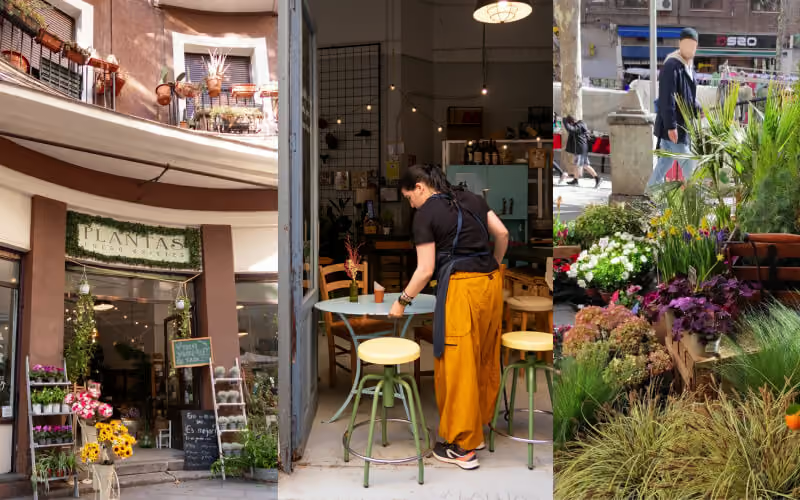
Author's tip: On the corner of Ribera de Curtidores and Calle del Carnero, Plantas Luego Existes looks from the street like a plant shop and nothing more, if a handsome one, with antique furniture among the pots. What the window does not say is that it also pours a very good glass of wine, to be drunk among the plants a few steps from the busiest stretch of the market. Most of the Sunday crowd walks straight past. The shop runs workshops and yoga classes as well, announced on its Instagram profile.
Why Madrid's flea market is called El Rastro
The street names give the history away. Curtidores means tanners. Madrid's first slaughterhouse was set up beside what is now Plaza de Cascorro in the fifteenth century, under the Catholic Monarchs, and the tanners who worked the hides settled on the slope below it. The rastro was the trail, by most accounts of blood, left as the cattle were moved between the two. In November 2025 the city council unveiled a plaque near the top of Ribera de Curtidores marking the heritage site.
The second-hand market that grew up around those trades is more than 250 years old by the city's own count, and some accounts put it past 400. It holds the title of Cultural Heritage of the People of Madrid. Its size is harder to pin down than its age. Figures of 3,000 stalls or more are still widely repeated, but official figures from the Council in July 2024 put the number of licensed traders at around 1,000.
Cash, haggling and what to watch for
None of that history has made the buying formal. Haggling is expected at the antique and second-hand stalls, where asking about a piece is the usual way in, and it gets little traction at stalls selling new clothes at marked prices. Cash is the safe assumption at the stalls; card readers are more reliably found in the shops and galleries.
The crowd is also the main thing to watch out for. With thousands of people moving along a single street, it is best to keep bags closed and in front of you, as you would at any busy event in a major city. The slope is another consideration. Ribera de Curtidores is steep, so comfortable shoes will make the walk much easier, while anyone with a pushchair may find the climb a little more challenging once the street gets busy.
After 15:00: Sunday lunch and the Saturday edition
When the stalls come down, the crowd moves into the bars of La Latina and the streets around the market for the aperitivo that is the other half of a Rastro Sunday. Several of the area's oldest addresses are within a short walk: Malacatín, serving cocido since 1895; Bar Santurce, where grilled sardines are eaten standing up; Casa Amadeo, known for snails in sauce; and Taberna Antonio Sánchez, open since 1787.
Anyone who cannot make a Sunday has a smaller alternative. Los Sábados de El Rastro sets up on Plaza del General Vara del Rey on the first Saturday of each month from 10:00 to 14:30, except in July and August, with antiques, vintage and collectors' stalls.
By late afternoon Ribera de Curtidores is an ordinary sloping street again, and the plaque marking the old slaughterhouse can be read without anyone standing in front of it.
My advice is to go without a shopping list. El Rastro is at its best on a Sunday with no plan: arrive early, follow whichever side street looks interesting, and stop when the vermouth calls. Whatever you were looking for will still be there next week (maybe), as the market has been every Sunday for longer than anyone can quite agree on.
FAQ
When and where is El Rastro in Madrid?
El Rastro takes place every Sunday and public holiday from 09:00 to 15:00 in the La Latina area of central Madrid. It starts at Plaza de Cascorro and runs down Calle de la Ribera de Curtidores to Ronda de Toledo, spreading into the side streets and squares on both sides. Entry is free.
What is the best time to go to El Rastro?
The best time to go is between 09:00 and 11:00, before the crowd builds. Late morning to midday is the busiest stretch, and stalls begin packing up at about 14:30, half an hour before the official close.
Which metro goes to El Rastro?
Metro lines 1, 3 and 5 serve El Rastro. La Latina (line 5) and Tirso de Molina (line 1) are closest to Plaza de Cascorro at the top of the market, while Puerta de Toledo (line 5) and Embajadores (line 3) are nearer the bottom end, by Ronda de Toledo.
What can you buy at El Rastro?
El Rastro sells both new and second-hand goods. Clothes, shoes and bags fill Ribera de Curtidores, paintings and art supplies are on Calle de San Cayetano, used books on Carlos Arniches and Carnero, and collectables such as trading cards, stamps, coins, vinyl, film cameras and antiques on the surrounding streets and squares.
How long does it take to see El Rastro?
Two to three hours is a realistic allowance for walking Ribera de Curtidores and the main side streets at browsing pace. The crowd after 11:00 slows the walk considerably, so an early start covers more ground in less time.
