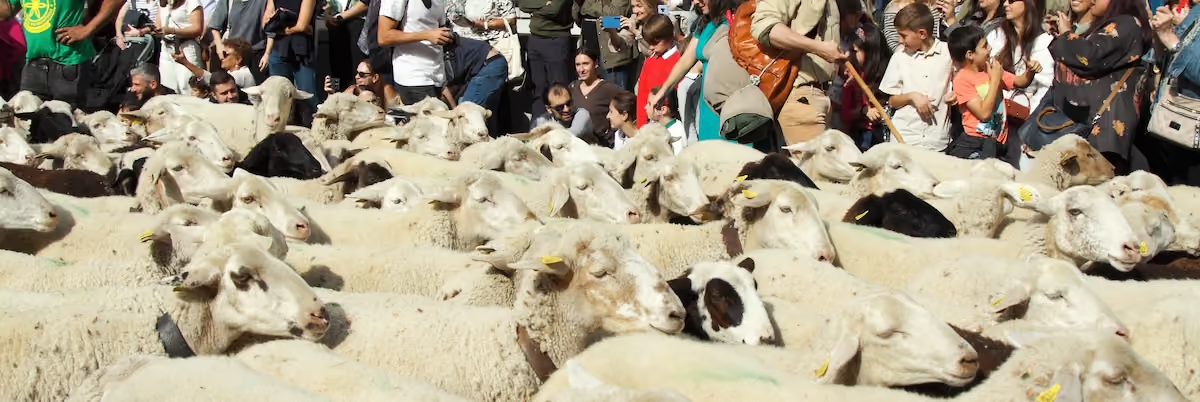
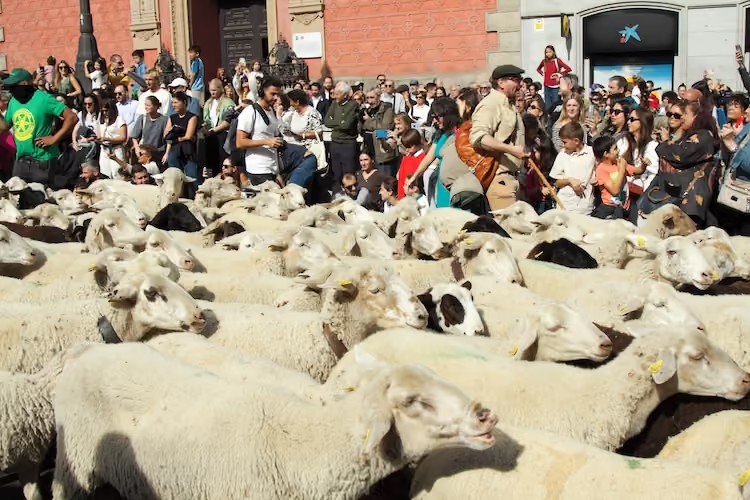


Every autumn, the Fiesta de la Trashumancia festival brings flocks of sheep and goats, their shepherds and folk groups into the centre of Madrid. Now in its 33rd edition, it surrounds the crossing with a programme of walks alongside the animals, wool workshops, talks and a cheese tasting at Casa de Campo.
What it is
Held since 1994, the festival is backed by Madrid City Council, with the Fundación Trashumancia y Naturaleza bringing the flock. Its case is practical: transhumance, the seasonal movement of livestock between pastures, helps conserve biodiversity and limit wildfires, and it depends on drovers' roads that are public land.
The main event is the passage of the flock through the city streets to City Hall on Plaza de Cibeles. There the shepherds hand over the maravedís, a symbolic payment for crossing the city, before the animals return to Casa de Campo. Breeders of native Spanish breeds and folk groups from regions linked by the drovers' roads walk with them.
In the days before, the CIEA Casa de Campo, the city's environmental education centre, runs sessions for adults and families, and two temporary exhibitions on transhumance and on the pastures of the Sistema Central stay open there until December.
The 2026 edition falls in the United Nations' International Year of Rangelands and Pastoralists, the subject of this video from the CIEA Casa de Campo.
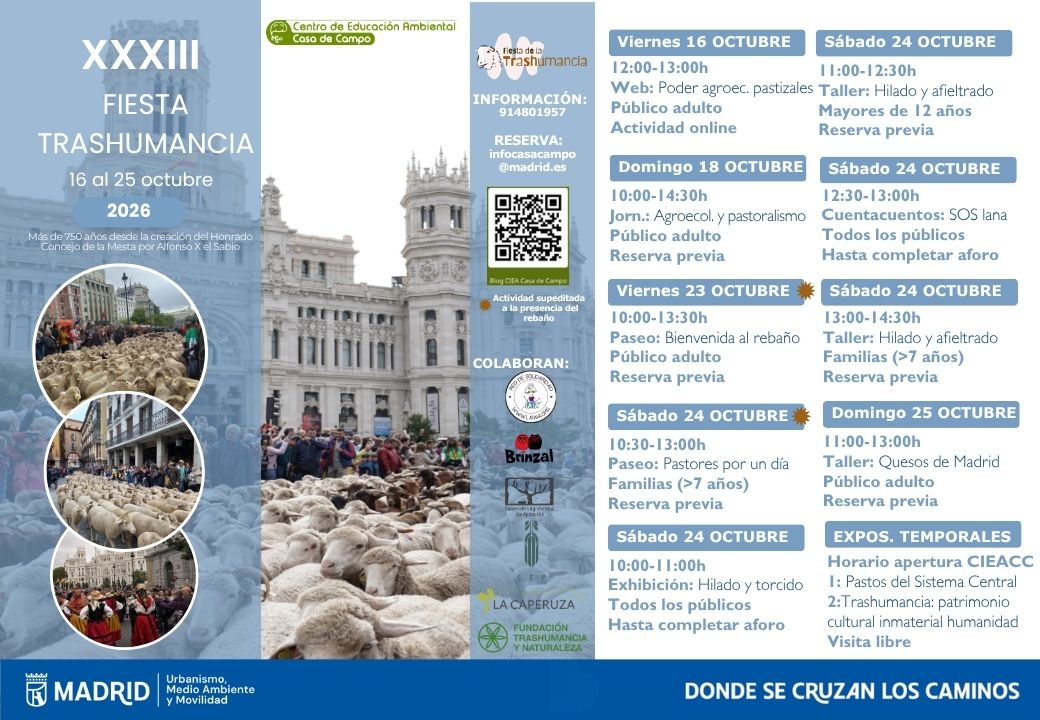
Fiesta de la Trashumancia 2026: day-by-day programme
The programme runs across five dates, almost all of it at the CIEA Casa de Campo. Sunday 25 October is the day the flock walks into the city centre.
Friday 16 October
- 12:00–13:00 · Webinar on the agroecological power of grasslands, with Sonia Roig Gómez of the Sociedad Española de Pastos. For adults, streamed live on the CIEA Casa de Campo YouTube channel.
Sunday 18 October
- 10:00–14:30 · Agroecology and pastoralism: four talks on the projects La Chanta, Apisquillos, Entrelobas and Javier de los Nietos, covering grazing to regenerate degraded land, urban grazing and livestock as a teaching tool. For adults. Booking required.
Friday 23 October
- 10:00–13:30 · Welcoming the flock: a walk with the transhumant flock from the outskirts of Pozuelo to its entry into Casa de Campo through the Puerta del Zarzón, helping the shepherds at road crossings. For adults. Booking required.
Saturday 24 October
- 10:00–11:00 · Wool spinning and twisting demonstration with Asociación La IAIA. All ages, no booking, up to 50 people.
- 10:30–13:00 · Shepherds for a day: a walk with the flock on its rest day in the Casa de Campo pastures, with the shepherds explaining their work. Families with children over 7. Booking required.
- 11:00–12:30 · Spinning and wet felting workshop for ages 12 and over: carding, spindle spinning and felt bracelets and necklaces to take home. Booking required.
- 12:30–13:00 · Storytelling session SOS lana, on wool being treated as waste and what can be done about it. All ages, no booking, up to 50 people.
- 13:00–14:30 · Spinning and wet felting workshop for families, from age 7. Booking required.
Sunday 25 October
- 10:00–13:30 · Fiesta de la Trashumancia: the flock crosses the city to City Hall for the handover of the maravedís, then returns to Casa de Campo. All ages. Timetable and route were still pending approval at the time of writing.
- 11:00–13:00 · Artisan cheeses of the Madrid region: a session with La Caperuza, a grazing farm and artisan dairy, with a guided tasting of its own goat's cheeses and yoghurts. For adults. Booking required.
October to December
- Exhibitions Trashumancia, patrimonio cultural inmaterial de la humanidad and La riqueza de los pastos del Sistema Central, open to all ages during the centre's opening hours.
Why it's worth your time
The crossing rests on a right of way that Spain's 1995 drovers' roads law still protects. The handover at Cibeles re-enacts the Concordia of 1418, under which shepherds paid the town council 50 maravedís per thousand head to cross its land. Calle de Alcalá was itself a stretch of a royal drovers' road, and an original stone waymarker, numbered 5, still stands opposite number 181. New for 2026 is the morning of talks on agroecology and pastoralism.
Practical info
Most Casa de Campo activities need booking by email at infocasacampo@madrid.es, which opens a month before each date. One person can book up to four places, and a place is confirmed only once the centre replies. The two open Saturday sessions take the first 50 people. The Friday and Saturday walks depend on the flock having arrived.
FAQ
When do the sheep cross Madrid in 2026?
The flock crosses central Madrid on Sunday 25 October 2026. The City Council's programme lists the event from 10:00 to 13:30, with the timetable and route still pending approval when it was published on 1 October. In 2025 the flock was scheduled to leave Casa de Campo at 10:00 and reach Plaza de Cibeles at 12:45.
What route do the sheep take through Madrid?
The traditional route starts at Casa de Campo and runs over Puente del Rey, along Paseo de la Virgen del Puerto and Parque de Atenas, up Cuesta de la Vega, then along Calle Mayor, through Puerta del Sol and down Calle de Alcalá to Plaza de Cibeles, returning the same way. The 2026 route had not been formally approved at the time of writing.
Why do shepherds pay 50 maravedís to Madrid City Council?
The payment re-enacts the Concordia of 1418, an agreement between the shepherds of the Mesta and Madrid's town council that set a toll of 50 maravedís per thousand head of livestock for using the drovers' roads across the municipality. City Council representatives receive the coins at Plaza de Cibeles after the agreement is read aloud.
How do I book the Fiesta de la Trashumancia activities at Casa de Campo?
Bookings are by email only, at infocasacampo@madrid.es, and open one month before each activity. One person can request up to four places, and a place is confirmed only by a reply from the centre. The street crossing on 25 October, the webinar and the two open Saturday sessions need no booking.
How many sheep take part in the Fiesta de la Trashumancia?
No figure had been published for 2026 at the time of writing. In 2025, more than 1,100 merino sheep and 200 goats crossed the city, guided by the Fundación Trashumancia y Naturaleza.
