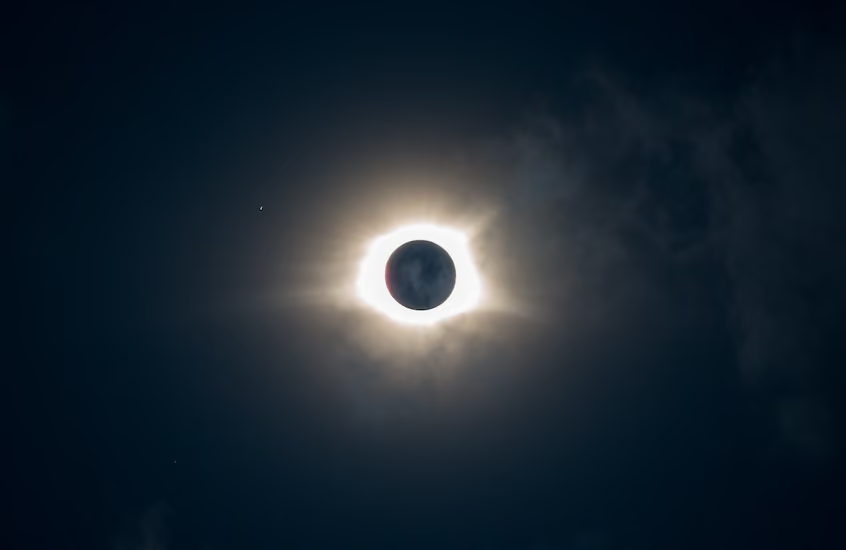


A total solar eclipse happens when the Moon passes directly between the Sun and Earth, blocking the Sun's disc completely and turning day briefly into night along a narrow shadow path. This summer, that path sweeps across northern Spain, the first total eclipse visible from the Iberian Peninsula since 1905, and the Community of Madrid sits squarely inside it. For a matter of seconds, daylight will fade to near-darkness as the region's Sierra Norte becomes one of the best places to watch it happen.
When it happens
The eclipse unfolds in three stages on 12 August 2026: the partial phase begins at 19:35, totality peaks around 20:30 and lasts between 30 and 90 seconds depending on location, and the partial phase continues until sunset at 21:19.
Duration of totality by municipality
Totality lasts under a minute and a half anywhere in the region, and varies by location:
- Somosierra: 1 minute 29 seconds
- La Cabrera: 1 minute 11 seconds
- El Molar: 1 minute 1 second
- Meco: 55 seconds
- San Agustín de Guadalix: 53 seconds
- Puerto de Navacerrada: 49 seconds
- Colmenar Viejo: 43 seconds
- Alcalá de Henares: 41 seconds
- Tres Cantos: 36 seconds
- San Sebastián de los Reyes: 35 seconds
Where to watch it
The path of totality runs through the northern and eastern Community of Madrid, and the regional government has enabled 51 municipalities as official viewing points, split roughly into four zones:
Sierra Norte / Lozoya valley (longest totality, rural setting): Somosierra, Prádena del Rincón, Braojos, Piñuécar-Gandullas, Berzosa del Lozoya, La Serna del Monte, Gascones, Villavieja del Lozoya, Puentes Viejas, Garganta de los Montes, Lozoya, Canencia, Valdepiélagos, Cabanillas de la Sierra, Navalafuente, Rascafría, Talamanca de Jarama, Valdeolmos-Alalpardo, Fresno de Torote and Soto del Real.
Corredor del Henares / east: Meco, Los Santos de la Humosa, Daganzo de Arriba, Pezuela de las Torres, Nuevo Baztán, Ambite, Villarejo de Salvanés, Chinchón and Perales de Tajuña.
Sierra Centro / Guadarrama: Navacerrada, Becerril de la Sierra, Los Molinos, Moralzarzal, Collado Mediano, Hoyo de Manzanares, San Lorenzo de El Escorial, Robledo de Chavela, Villamantilla, Chapinería, Brunete, San Martín de Valdeiglesias, Navas del Rey, Santa María de la Alameda, Olmeda de las Fuentes and Torrejón de la Calzada.
Northern metropolitan ring: Colmenar Viejo, El Molar, La Cabrera, San Agustín de Guadalix, San Sebastián de los Reyes, Tres Cantos, and Buitrago del Lozoya, which also hosts the region's main festival.
Central Madrid falls outside the path of totality and will see a partial eclipse instead.
Festival del Eclipse, Buitrago del Lozoya
The flagship gathering is the Festival del Eclipse, organised with Buitrago del Lozoya town hall at the Piscinas de Riosequillo recreation area, with foodtrucks, live music, children's workshops and an exhibition on the science of the phenomenon. Free registration for the 3,000 available places has already sold out.
How to watch safely
Looking directly at the sun without protection can cause permanent eye damage, even during the partial phase. ISO 12312-2 certified eclipse glasses are the only safe option for the naked eye; sunglasses, smoked glass, X-ray film and unfiltered phone or camera lenses don't work. The Community of Madrid is distributing 36,500 new pairs on top of 20,000 already handed out at schools and the Madrid es Ciencia fair, available free at the observation points.
Getting there
The regional transport authority (CRTM) is reinforcing bus lines 191 and 193 from the Plaza de Castilla interchange to Buitrago del Lozoya and the Pedrezuela-Venturada area, plus extra services on lines 725, 726, 691 and, for the Corredor del Henares, 223 and 222.
FAQ
When is the total solar eclipse in Madrid in 2026?
The eclipse takes place on 12 August 2026, with the partial phase beginning at 19:35 and totality reaching its peak around 20:30, before the partial phase continues until sunset at 21:19. It's the first total solar eclipse visible from the Iberian Peninsula since 1905, and the first of three consecutive eclipses crossing Spain through 2028.
Where can I see the total eclipse near Madrid?
The path of totality crosses 51 municipalities in the northern and eastern Community of Madrid, grouped around the Sierra Norte, the Corredor del Henares, the Sierra Centro and the northern metropolitan ring. Central Madrid falls outside the path of totality and will see a partial eclipse instead.
How do I get free eclipse glasses in Madrid?
Free ISO-certified eclipse glasses are distributed at the 51 regional observation points. The Community of Madrid has issued 36,500 new pairs on top of 20,000 already handed out at the Madrid es Ciencia fair and in schools.
Will the eclipse be visible from central Madrid city?
Central Madrid falls outside the path of totality, so the sun's disc won't be fully covered there. The city will see a partial eclipse only, at the same time as the wider region. To experience totality, when the sky briefly turns to near-darkness, visitors need to reach one of the 51 municipalities inside the path, mostly to the north and east of the capital.
How long does totality last during the 2026 Madrid eclipse?
Totality lasts between 30 and 90 seconds across the Community of Madrid, depending on location: around a minute and a half in Somosierra, at the northern edge of the path, down to roughly 35 seconds in San Sebastián de los Reyes, near its southern limit. Outside the 51 designated points, the region sees only a partial eclipse.