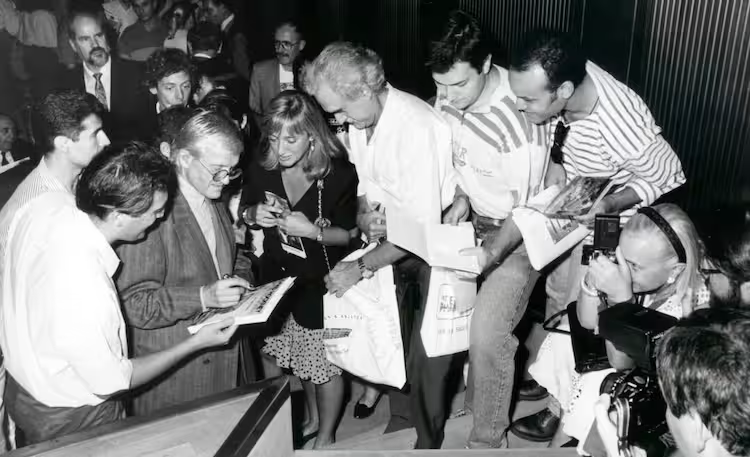


This exhibition at the Fundación Juan March tells the story of how modern and contemporary art arrived in Spain, and it does so through the public rather than the artists. It follows who first saw works by Kandinsky, Duchamp or Matisse, where they saw them, and why the country met them at least thirty years after its Western neighbours.
What it is
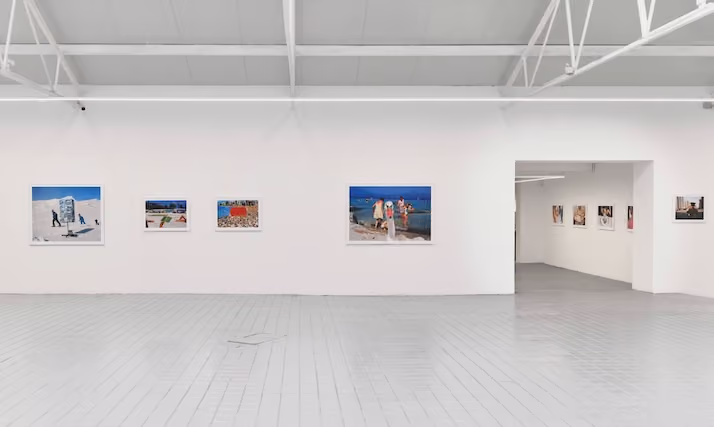
La transición estética. España, 1960-2020 gathers more than 200 works and documents, from paintings to books, magazines, records, fanzines, photographs and audiovisuals. Instead of a conventional art history, it builds around case studies of about seventy artists and shows how public institutions, private galleries and countercultural spaces spread modernity in Spain.
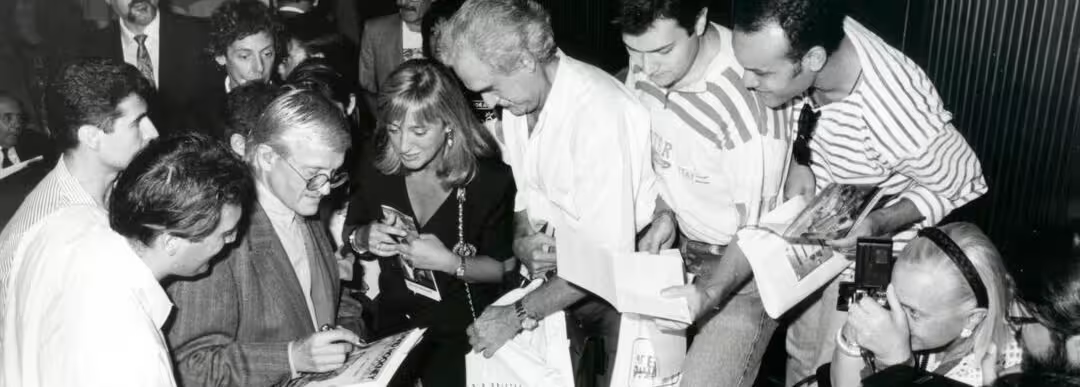
The roll call is broad: Kandinsky, the Russian avant-gardes, Meret Oppenheim, Maruja Mallo, Remedios Varo, Gunta Stölzl and Anni Albers, Matisse, Duchamp, Klee, Giacometti, Motherwell, Joseph Kosuth, John Cage, Ana Mendieta and Marina Abramović. Revealing episodes anchor the story. In 1960, thirty Picasso paintings at the Sala Gaspar in Barcelona drew crowds so large that the city council posted guards.
In January 1983, Madrid hosted Andy Warhol at Galería Fernando Vijande and Roy Lichtenstein at the Fundación Juan March, a street apart. The route runs up to recent decades.
Why it's worth attending
It offers a different way into familiar names by asking how audiences learned to see them. The curators, José María Parreño, Germán Labrador Méndez and Manuel Fontán del Junco, worked with around fifty specialists across visual culture, music, design, radio, television and the press. The result is a visual history of a country's taste, extended beyond the galleries by a documentary film and an oral history series.
Practical info
Free guided visits run in Spanish on Tuesdays and Thursdays at 11:00, 12:00 and 13:00 and on Wednesdays and Fridays at 17:00, 18:00 and 19:00, for up to 15 people on a first-come basis (not on holidays). English visits are on Wednesdays at 11:00, 12:00 and 13:00, with a minimum of eight people, booked at march.es/visitasingles. Closed 24, 25 and 31 December and 1 and 6 January.
FAQ
Is La transición estética free to visit?
Yes. Admission to the Fundación Juan March exhibitions is free. The show runs from 16 October 2026 to 10 January 2027 at Calle Castelló 77, and free guided visits in Spanish and English are offered on set days, with places limited to 15 people per Spanish tour.
Which artists appear in La transición estética?
The case studies include Kandinsky, Meret Oppenheim, Maruja Mallo, Remedios Varo, Gunta Stölzl, Anni Albers, Matisse, Duchamp, Klee, Giacometti, Motherwell, Joseph Kosuth, John Cage, Ana Mendieta and Marina Abramović, alongside Spanish artists. The exhibition selects about seventy artists and studies how each first reached Spanish audiences.
Who curated La transición estética?
The curators are José María Parreño, of the Universidad Complutense, Germán Labrador Méndez, of the CSIC, and Manuel Fontán del Junco, director of Museums and Exhibitions at the Fundación Juan March. Around fifty specialists collaborated on the project.
Are there guided visits in English?
Yes. English-language guided visits take place on Wednesdays at 11:00, 12:00 and 13:00, with a minimum of eight people. Reservations are made at march.es/visitasingles. Spanish visits are free and run on Tuesdays to Fridays, with a maximum of 15 people and no booking, by order of arrival.
What are the film and oral history linked to the exhibition?
The film Autorizada para todos los públicos, directed by Javi Álvarez, premieres on 30 November and covers cultural transitions in Spain. The Cuéntennos project adds about twenty video interviews with protagonists of art and culture, published on Canal March.