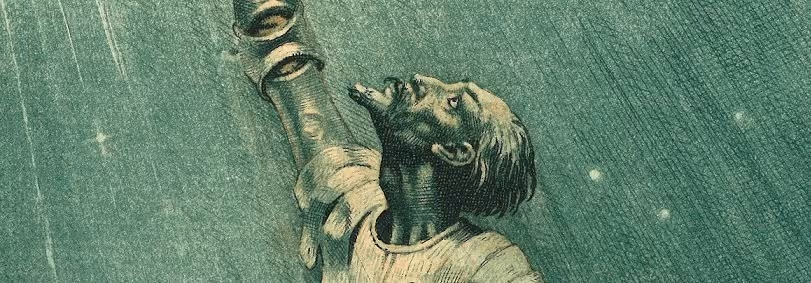
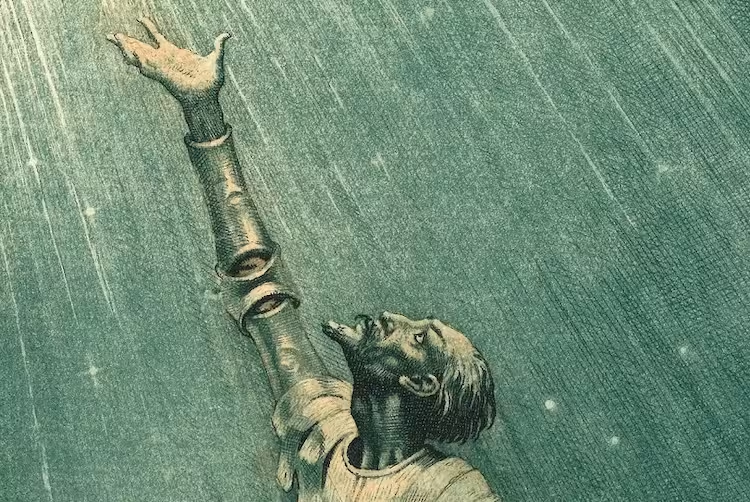


This exhibition on astronomy in Cervantes' time at the Museo Casa Natal de Cervantes, in Alcalá de Henares, looks up at the sky the way the writer's contemporaries did. It explores how the cosmos was understood in the age of Don Quixote's author, with a timely hook: Spain will see three striking eclipses across 2026, 2027 and 2028.
What it is
Inclinado de mi estrella. La astronomía en época de Cervantes is a temporary exhibition organised by the Dirección General de Cultura e Industrias Creativas. It reconstructs how astronomy and cosmography were conceived around 1600. Cervantes lived between the sixteenth and seventeenth centuries and shared his era with Giordano Bruno, Tycho Brahe, Johannes Kepler and Galileo Galilei.
Learned thinking still leaned on the Greco-Roman tradition and on the geocentric model of Ptolemy, which put the Earth at the centre of the universe. Cervantes' own pages show a different picture for ordinary people: the sky was less a scientific explanation than a mix of everyday experience, inherited beliefs and religious teaching, far from the academic debates then taking shape.
A free cultural mediation service completes the show, with a museum educator accompanying visitors through the room, and a room guide can be downloaded from the museum's website.
Why it's worth your time
It pairs a literary landmark with a very current reason to look up. The show sits inside the museum devoted to the writer's birthplace in Alcalá de Henares, so Cervantes' world is read on the spot where it began. Aimed at all audiences, it explains the sky of his day through the writer's own texts, and the coming eclipses give the subject fresh relevance for anyone curious about how people watched the stars four centuries ago.
Practical info
The museum is closed on Mondays and on 24, 25 and 31 December and 1 and 6 January. Last admission is 30 minutes before closing, and groups of more than eight people need to book. Free mediation in the room runs on Wednesdays at 12:00, 13:30 and 16:30 and on Fridays at 12:00 and 13:30, lasts about 30 minutes and needs no reservation. By train, take Cercanías C2, C7 or C8; by bus, line 223 from Avenida de América.
FAQ
Is the Inclinado de mi estrella exhibition free?
Yes. Entry to the exhibition and the museum is free, and visits of one to eight people need no reservation. Groups of more than eight count as group visits and must book in advance. The in-room cultural mediation service is also free and runs on Wednesdays and Fridays.
How do I get from Madrid to the Museo Casa Natal de Cervantes?
Alcalá de Henares is served by Cercanías lines C2, C7 and C8, and bus 223 leaves from the Avenida de América interchange. The museum stands on Calle Mayor in the historic centre, an area the Spanish tourism board describes as a UNESCO World Heritage site.
What is the Inclinado de mi estrella exhibition about?
It shows how astronomy and cosmography were understood in Cervantes' lifetime, between the sixteenth and seventeenth centuries. It draws on the writer's texts to show how ordinary people related to the sky, and it links the theme to three eclipses visible from Spain in 2026, 2027 and 2028.
Which astronomers lived in Cervantes' time?
Cervantes was a contemporary of Giordano Bruno, Tycho Brahe, Johannes Kepler and Galileo Galilei. The exhibition places his world against the dominant model of the era, Ptolemy's geocentric universe, which put the Earth at the centre of the cosmos.
Is there a guided visit for the exhibition?
Yes, a free mediation service with the museum educator runs on Wednesdays at 12:00, 13:30 and 16:30 and on Fridays at 12:00 and 13:30. Each session lasts about 30 minutes, needs no reservation and is aimed at visitors who come to the museum on their own.