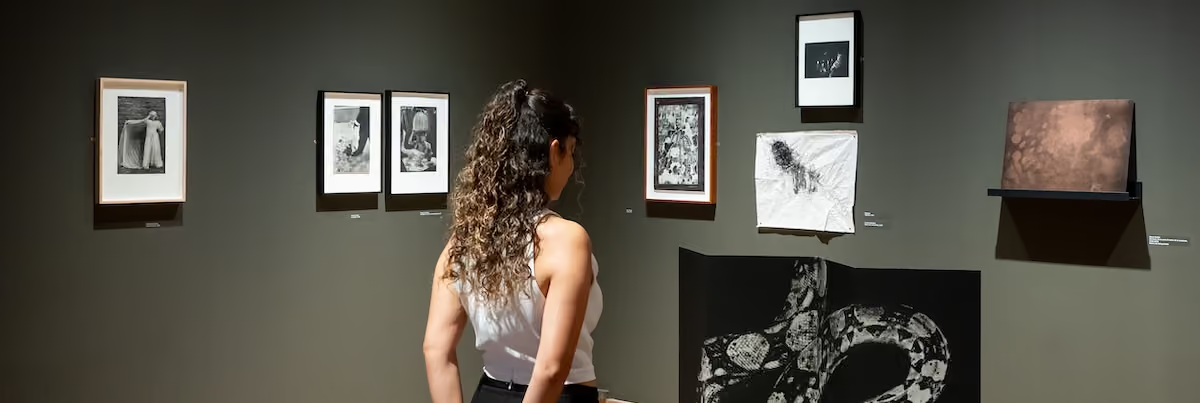
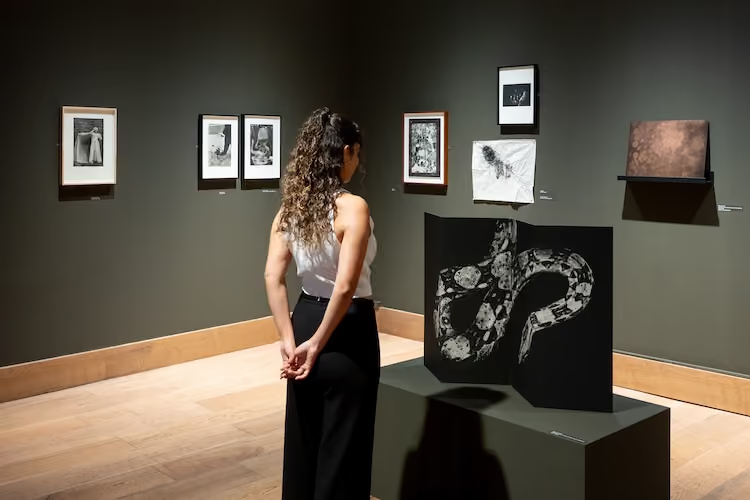


In a collective exhibition at Fundación Casa de México, 19 Mexican artists approach death through heliogravure, a nineteenth-century printing technique that turns a photograph into a copper plate. The show gathers 31 works made for the occasion, on grief, memory, absence and the traces left by those who are gone.
What it is
La muerte nuestra de cada día brings together artists of different generations and careers, among them Graciela Iturbide, Maya Goded, Héctor García and Martín Soto Climent. Each responds to death and what surrounds it: absence, mourning, memory, disappearance, identity and the transformation of bodies and territories.
Curator Edgar Alejandro Hernández produced the show with Helio TM, a Mexico City workshop founded in 2021 to recover traditional photographic printing, and with Pilar Goutas. Heliogravure transfers an image to a copper plate, which is worked with engraving methods and printed on paper. Most pieces are prints on 350 g Hahnemühle paper, alongside chine collé, Japanese paper and copper matrices; some add embroidery, tempera, silver or polyurethane varnish.
The approaches are personal, social and symbolic rather than folkloric: some start from family loss, others from funeral rituals, violence, migration or spirituality.
Why it's worth your time
The show does not repeat the most familiar Mexican images of death. It widens the conversation towards how people face loss and build memory today. It also puts a historical printing method at the centre of a contemporary reflection: the plate, the ink, the pressure and the mark become ways to speak about what remains, changes or disappears. With 19 artists across generations, it shows how many registers heliogravure can hold in current practice.
Practical info
The exhibition is in the Sala de proyectos on the ground floor (planta 0) of Casa de México in Chamberí, a short walk from Argüelles and San Bernardo metro stations. The organiser lists it as suitable for the general public.
FAQ
What is heliogravure?
Heliogravure is a nineteenth-century photomechanical printing process that transfers a photographic image onto a copper plate. The plate is then worked with different engraving techniques and printed on paper. For this exhibition, the Mexico City workshop Helio TM produced the 31 works together with the participating artists.
Which artists take part in La muerte nuestra de cada día?
Nineteen Mexican artists take part: Andrea Aspe, Ángela Arziniaga, Arturo Fuentes, Carmen Mendoza, Cristina Kahlo, Cristóbal Gracia, Fernanda de Icaza, Gerardo González, Graciela Iturbide, Guillermo Espinosa, Héctor García, Martín Soto Climent, Maya Goded, Miguel G. Counahan, Piguame, Pilar Goutas, Santiago Borja, Tamara Goutas and Yvonne Venegas.
Do I need a ticket to visit the exhibition at Casa de México?
The organiser presents the exhibition as free and open to the public, with no ticket price. It can be visited during the centre's regular opening hours: Monday 10:00 to 19:00, Tuesday to Saturday 10:00 to 21:00 and Sunday 10:00 to 14:00.
Who curated the exhibition and who produced the prints?
Edgar Alejandro Hernández curated it. He is an editor, researcher, curator and art critic born in Mexico City in 1977, and he directs the magazine Cubo Blanco. The prints were produced with Helio TM, a heliogravure workshop founded in 2021 and directed by Miguel G. Counahan, and with Pilar Goutas.
Is the exhibition about Day of the Dead traditions?
Not in a folkloric sense. The organisers say the show avoids a uniform reading of Mexico's relationship with death and does not aim to reproduce its best-known images. Its works range from personal loss and family experiences to funeral rituals, violence, migration and spirituality, looking at how people face loss and build memory today.